
 русский
  Español
  عربى
عربى Industry News

GET A QUOTE
Choosing a Lever Handle Smart Lock That Actually Fits Your Home
A front door used to be a simple thing: a slab of wood or metal with a lock in it. That's changed. For a lot of households, the door is now tangled up with daily routines — who comes and goes, when, and how. So it's no surprise that Lever Handle Smart Locks have become a bigger part of the conversation when people think about upgrading their entryway. But swapping in a smart lock isn't really a one-size-fits-all decision. A family with young kids cares about different things than someone who's on a plane every other week. Someone renovating a rental property has a completely different list of priorities than a couple settling into their forever home. Once you start thinking about it in terms of how you actually live — rather than a spec sheet — the choice gets a lot less overwhelming.
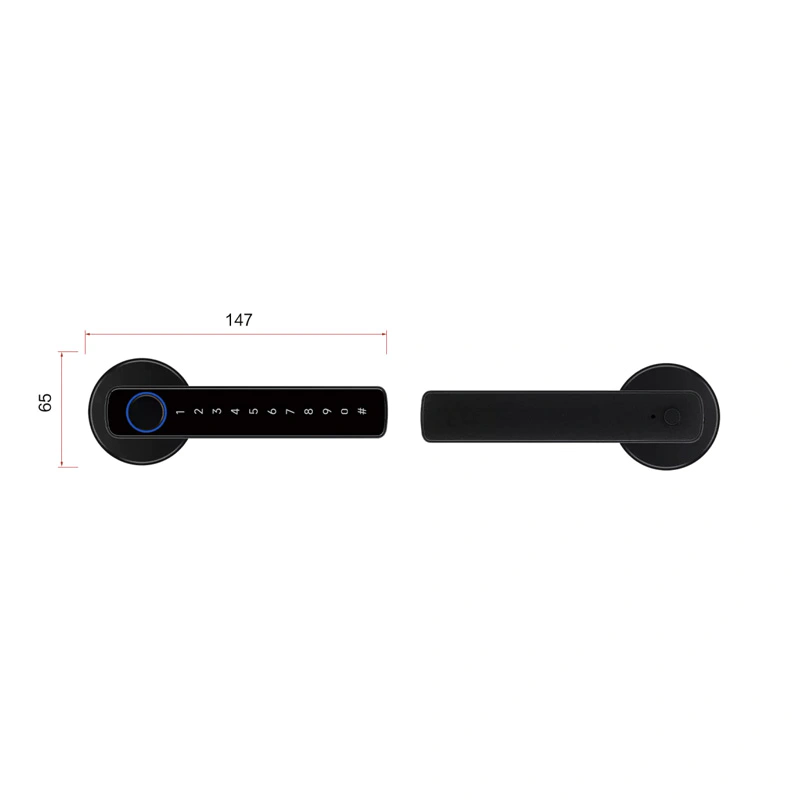
Why Lever Handle Smart Locks are catching on
Regular locks still do their job. Nobody's arguing otherwise. But daily life has shifted in ways that make a plain key-and-deadbolt setup feel limited.
Packages show up when nobody's home. Kids get home from school before parents do. A dog walker or a cleaner needs to get in twice a week without you handing out spare keys to half the neighborhood. These aren't edge cases anymore — they're just Tuesday.
Lever handles specifically have an advantage here: they feel familiar. You're not asking grandma or a five-year-old to learn some new motion to get through the front door. You push down, it opens — same as always — except now there's more going on behind that simple movement. That's really the appeal: not reinventing the door, just making the hardware behind it smarter.
Start with the door, not the catalog
Most people start shopping by browsing finishes or comparing app features. Honestly, a better starting point is standing in front of your actual door and asking a few boring but useful questions:
- What's the door made of — wood, steel, fiberglass?
- How much traffic does this entrance really see?
- Is this for a single-family home, an apartment, a rental, or an office?
- How many people need reliable access on a normal day?
- Does your climate throw humidity, salt air, or big temperature swings at exterior hardware?
- Are you keeping the existing handle set, or replacing everything?
None of this is exciting, but it narrows the field fast. A two-person household has a very different set of needs than a home where three generations are coming and going at different hours.
Daily comfort matters more than people expect
It's easy to get pulled toward the features you'll use once a month — guest codes, activity logs, whatever. The thing you'll actually notice is how the lock feels when you're using it for the hundredth time that week.
Picture the ordinary moments: hands full of grocery bags, coming back sweaty from a run, an older relative whose grip isn't what it used to be, a kid juggling a backpack and a phone. If the lever feels clunky or the app takes twenty seconds to respond, you'll feel that friction constantly. If it's smooth, you stop thinking about it entirely — which is really the goal.
This extends past the mechanical action, too. A confusing app menu or vague status lights can be just as annoying as a stiff handle. Simpler usually wins over "more powerful but confusing."
Matching access methods to how your household actually behaves
Some people want to leave the house with nothing in their pockets. Others still like the reassurance of a physical key as backup. Most households end up wanting a mix.
| If your household looks like... | You'll probably lean toward... |
|---|---|
| Family with kids | Multiple access options for different ages |
| Apartment dwellers | Quick, low-fuss daily entry |
| Frequent travelers | Reliable remote access and monitoring |
| Multi-generational household | A range of methods suited to different habits |
| Rental property | Easy-to-manage temporary access |
| Home office | A separate way in for clients or visitors |
There's no universally "correct" access method — the right one just depends on who's actually walking through that door every day.
Does it need to look good too?
Yes, honestly — more than people admit. A front door handle gets touched every single day, and it sits right there in the most visible part of your home's exterior. A lock that clashes with the door or the trim tends to stand out for the wrong reasons.
Some people want something understated that almost disappears into the door. Others want a statement piece. Neither instinct is wrong — it comes down to your door color, the surrounding trim, your porch lighting, and whatever design language the rest of your entryway already speaks. Function should come first, but don't treat looks as an afterthought; you'll be looking at this thing every day for years.
Installation isn't just a one-afternoon task
How the lock goes in affects how it performs for years afterward. A model that fits your existing door prep without drilling new holes or replacing the whole handle set is going to save you a headache — and money.
Before buying, it's worth a quick inspection: take a look at your current handle, check whether the door itself is warped or swelling, measure the space around the frame, and figure out if you'll need extra hardware like a strike plate adapter. Whether you're hiring someone or doing it yourself on a Saturday, a little prep beforehand avoids the "wait, this doesn't fit" moment mid-install.
And once it's in, the door should still open and close the way it always did — smoothly, without extra force. If installation changes how the door swings or seats, something's off.
Reliability is really about not thinking about it
Reliability sounds like a tech spec, but in practice it's just about routine. You get home tired, and you want the door to work — no fumbling, no error message, no dead battery surprise.
Where you live plays a role here. Coastal air, heavy humidity, or wide seasonal temperature swings all put more stress on exterior hardware than a mild, dry climate would. A little upkeep goes a long way: wipe down the exterior periodically, check that the latch and lever move freely, swap batteries before they die rather than after, and don't force the mechanism if something feels stuck — that's usually a sign to investigate, not push harder.
Not every smart feature deserves a spot on your door
Modern smart locks pack in a long list of digital extras, and it's tempting to chase the model with the most checkboxes. A more useful exercise is picturing your actual week.
Do different family members need different ways in? Will delivery drivers or occasional guests need temporary access? Would getting a notification when someone unlocks the door actually give you peace of mind, or just be noise? Are your routines likely to shift in the next year or two?
Answering those honestly usually points to a smaller, more useful set of features than the full spec sheet suggests. The best setup supports your life quietly — it shouldn't feel like one more app to babysit.
Think a few years ahead, not just today
Households change. Kids grow up and start coming home later — or leave for college. A family member moves in to help with caregiving. Someone starts working from home and needs to let clients in occasionally. Maybe the house becomes a rental down the line.
You don't need to map out every possibility, but it's worth asking whether the lock you're buying today can flex if any of that happens. Will you need to add more users? Will short-term access become more common? Could remote management matter more later than it does right now? A little flexibility now saves you from replacing the whole system in three years.
A short checklist before you buy
| Question | Why it matters |
|---|---|
| Does it fit your existing door without major changes? | Avoids surprise installation costs |
| Is it comfortable to use every single day? | This is what you'll actually notice |
| Can everyone in the house use it easily? | Kids, grandparents, guests — all of them |
| Does it match your entryway's look? | You'll see it every day for years |
| Do the access methods match how people actually come and go? | Real usage beats theoretical features |
| Could your household's needs shift down the road? | Saves a costly re-do later |
| Is upkeep simple? | Keeps it working without hassle |
Different households will weigh these differently — one family might care most about looks, another about ease of access, a person living alone might prioritize something else entirely. There's no universal answer here. The best approach is thinking less about spec sheets and more about the small, repeated moments a lock is actually part of: leaving in the morning, coming back tired at night, letting a guest in, hearing the latch click shut behind you. Get that part right, and everything else tends to fall into place.
Recommended Products

Ready to Begin?
Product Categories
Contact Information
 Email: [email protected]
 Phone: +86-13575699186
 Address: No.135, Wanyu Road, Zhiying Industrial Zone, Yongkang City, Zhejiang Province, China.
QR Code
Copyright © Yongkang Ruian Lock Industry Co, Ltd. All rights reserved.
